Showing posts with label identity and language. Show all posts

Monday, June 11, 2012

Reading from Eva Hoffman’s excellent book “Lost in Translation: A Life in a New Language”, I came across this passage and had to share it:

"When my friend Penny tells me that she’s envious, or happy, or disappointed, I try laboriously to translate not from English to Polish but from the word back to its source, to the feeling from which it springs. Already, in that moment of strain, spontaneity of response is lost. And anyway, the translation doesn’t work. I don’t know how Penny feels when she talks about envy. The word hangs in a Platonic stratosphere, a vague prototype of all envy, so large, so all-encompassing that it might crush me - as might disappointment or happiness.

I am becoming a living avatar of structuralist wisdom; I cannot help knowing that words are just themselves. But it’s a terrible knowledge, without any of the consolations that wisdom usually brings. It does not mean that I’m free to play with words at my wont; anyway, words in their naked state are surely among the least satisfactory play objects. No, this radical disjoining between word and thing is a desiccating alchemy, draining the world not only of significance but of its colors, striations, nuances - its very existence. It is the loss of a living connection.

The worst losses come at night. As I lie down in a strange bed in a strange house - my mother is a sort of housekeeper here, to the aging Jewish man who has taken us in in return for her services - I wait for that spontaneous flow of inner language which used to be my nighttime talk with myself, my way of informing the ego where the id had been. Nothing comes. Polish, in a short time, has atrophied, shriveled from sheer uselessness. Its words don’t apply to my new experiences; they’re not coeval with any of the objects, or faces, or the very air I breathe in the daytime. In English, words have not penetrated to those layers of my psyche from which a private conversation could proceed. This interval before sleep used to be the time when my mind became both receptive and alert, when images and words rose up to consciousness, reiterating what had happened during the day, adding the day’s experiences to those already stored there, spinning out the thread of my personal story.

Now, this picture-and-word show is gone; the thread has been snapped. I have no interior language, and without it, interior images - those images through which we assimilate the external world, through which we take it in, love it, make it our own - become blurred too. My mother and I met a Canadian family who live down the block today. They were working in their garden and engaged us in a conversation of the the “Nice weather we’re having, isn’t it?” variety, which culminated in their inviting us into their house. They sat stiffly on their couch, smiled in the long pauses between the conversation, and seemed at a loss for what to ask. Now my mind gropes for some description of them, but nothing fits. They’re a different species from anyone I’ve met in Poland, and Polish words slip off of them without sticking. English words don’t hook on to anything. I try, deliberately, to come up with a few. Are these people pleasant or dull? Kindly or silly? The words float in an uncertain space. They come up from a part of my brain in which labels may be manufactured but which has no connection to my instincts, quick reactions, knowledge. Even the simplest adjectives sow confusion in my mind; English kindliness has a whole system of morality behind it, a system that makes “kindness” an entirely positive virtue. Polish kindness has the tiniest element of irony. Besides, I’m beginning to feel the tug of prohibition, in English, against uncharitable words. In Polish, you can call someone an idiot without particularly harsh feelings and with the zest of a strong judgment. Yes, in Polish these people might tend toward “silly” and “dull” - but I force myself toward “kindly” and “pleasant.” The cultural unconscious is beginning to exercise its subliminal influence.

The verbal blur covers these people’s faces, their gestures with a sort of fog. I can’t translate them into my mind’s eye. The small event, instead of being added to the mosaic of consciousness and memory, falls through some black hole, and I fall with it. What has happened to me in this new world? I don’t know. I don’t see what I’ve seen, don’t comprehend what’s in front of me. I’m not filled with language anymore, and I have only a memory of fullness to anguish me with the knowledge that, in this dark and empty state, I don’t really exist."


Wednesday, August 3, 2011

Lexicon Valley

So, I was listening to NPR's show "On the Media" and this segment came up unexpectedly...it was great!

Back by popular demand, here's another installment of Mike Vuolo's "Lexicon Valley." In February 2010, the last living speaker of Boa died, and with her, the logic, culture, and history of the ancient people. Mike and Bob discuss the death of languages and why their passing matters. http://www.onthemedia.org/2011/jul/29/lexicon-valley-episode-2/

Tuesday, August 10, 2010

WORDS -- by Radiolab


So I've been listening to this great radio show/podcast for about six months now and I've obsessively listened to their whole back catalogue of shows now. Now I have to be content listening to the new episodes as they come out, which is more slowly than I'd like. It is that good. Anyway, everyone should check the show out (http://www.wnyc.org/shows/radiolab/), or download the podcast on iTunes... To the point: the newest episode is called "WORDS" and it really blew my mind. Many of their episodes are appropriate for this forum. The show essentially takes a seemingly very simple question, concept, or idea, and tries to explore it in depth in a number of ways (through the sciences, math, philosophy, art, etc.). It hasn't failed to fascinate me yet. So go check out the latest episode and then I think you'll be hooked.

Wednesday, September 17, 2008

I MAY BE PARANOID, BUT NOT AN ANDROID

Random (long and sporadic and nonlinear) thought (TURN BACK NOW).

I wonder how much of our language is spent on denial. Before most people can see the meaning behind any symbol or concept they usually meet that symbol concept with resistance or contention. Whether you are looking at the Greek alphabet as jibberish or hearing about how "Language Speaks Us," we spend a remarkable amount of time putting up a fight against something we simply do not understand yet (take African Americans or Homosexuals in America for example).
When I first heard Scott say "Language Speaks Us" I liked the idea but didn't really "eat it up". However, last night I was watching a fascinating video on TED.com (for the second time) about how the agricultural revolution may not have been a technological invention by humans, but rather, that it was actually a co-evolutionary development where things such as grasses evolved to exploit us (humans) into doing their dirty work for them (deforesting the competition, etc.). He got this idea while planting his garden. He saw a bee pollinating a flower and he thought "ha, that bee has no clue that he is compelled by the flower to do what he is doing. But I know that he is." Then he went back to gardening. But then he realized, that he was not much different than the bee. And that maybe gardening was so enjoyable for people because they are also being compelled by the plants to keep them in fruition.
So anyway (these thoughts are not entirely linear), I was thinking about this, and how absurd it seemed, and I was making up reasons to deny it and so forth and while doing so I thought of Language Speaking Us. And I thought, maybe language doesn't necessarily SPEAK US, but maybe language (meaning and symbols) somehow compel us to speak it - Rousseau did say that language grew out of need, right?

Now, of course, this can't necessarily be; considering that language is not a THING per se, but really a confluence of THINGS... but how are we (humans) any different? We THINK we compel things to do what we want them to. We think we have this power over language and that it can't possibly speak us. WE SPEAK IT, IT'S ABSURD TO SAY IT SPEAKS US, IT'S NOT A THING, IT'S LANGUAGE! But we're no different. We evolved with language. We're more advanced because of language and language is more advanced because of us. And the last I checked a human has never made language cry (aside from those horrible Karaoke songs), but language makes humans cry (and laugh and so on) ever single minute. We are shaped by language and we evolve because language evolves - and vice versa.

Now, of course (once again), I am babbling, and my thoughts are abstract and nonlinear and people will disagree and argue and so on, but we couldn't engage in such activity without it.

So, in conclusion, and since I tie EVERYTHING back to RADIOHEAD (because they created the heavens and the earth)... And this post is no different - as it was inspired by them (in a way). I was listening to their song PARANOID ANDROID. And during the chorus - barely noticable in the background - there is an audio recording of a robot's "voice" saying "I MAY BE PARANOID, BUT NOT AN ANDROID." And with EVERYTHING ELSE (language speaking us, agriculture as a co-evolutionary byproduct, etc.) I thought... try explaning that to this android... that he is not an android. If this thing actually existed - I wish it did - it would be nothing more than a machine that is programmed to feel paranoia and to doubt that it is what it is. I don't think we're much different. Human beings always ascribe their own species as the "BEST" species. I'm sure that penguins would do the same if they had as much denial as we do.

Here's the link to that TED VIDEO I mentioned: http://www.ted.com/index.php/talks/michael_pollan_gives_a_plant_s_eye_view.html

thefuckingend--sorry if my post is not proper enough to cause the effect of discussion.


PS: I think that people should come here and vent their thoughts more often. Don't use spell-checker and rewrite your thoughts in some WORD filter. Just get these things out of your head, and on to this blog. They're always the most interesting to read. You can recant in class.

Sunday, September 14, 2008

Peter Nadas, "Fire and Knowledge"

In July, Deborah Eisenberg published a review of the Hungarian writer's newly translated book of fiction and essays. One of the essays, "Homecoming," includes musings by the author after early successes as a writer:


These torments increased to the point where after the execution of a few polished short stories, not only did I become dissatisfied with my sentences, but I also felt the punctuation of my sentences was invalid and false. Commas and periods, dashes and question marks: they were all false. I found paragraphs even more repulsive. . . .

I felt I was putting punctuation marks here or there because that's how others were doing it, without comprehending their relation to me; so my marks had only a global meaning but no personal value. And the more faithfully I served this consensually accepted global sense, the more I distanced myself from my personal requirements.

In other words, language was speaking him.

Friday, September 5, 2008

Language and Identity

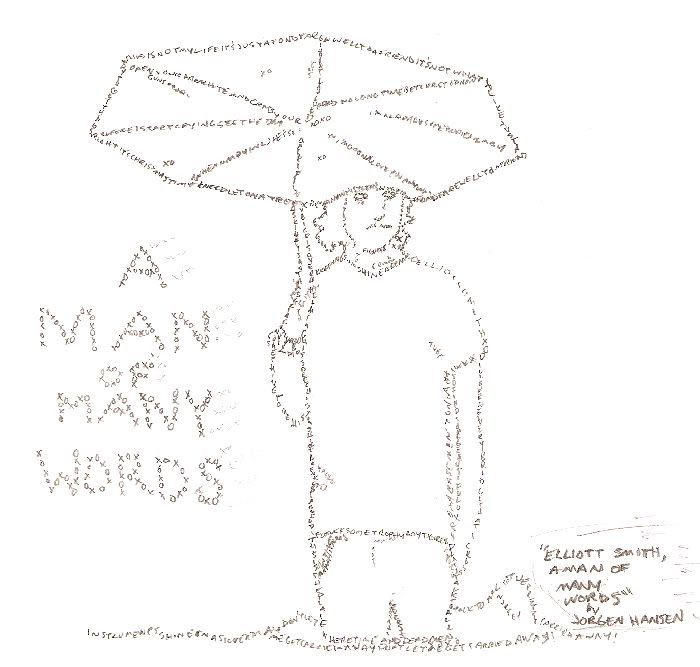
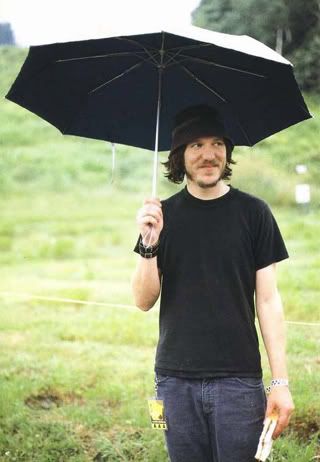
In class we are speaking about how language contributes largely to our identity (or how Language Speaks Us). While thinking about this I drew (with my lack of artistic talent) a picture of Elliott Smith (Born 1969 - Died 2003: from the portrait of him standing in a black shirt, holding an umbrella - picture below), but instead of drawing with lines, I used only lyrics from his songs, album titles, or quotes of his (and once I used his name). I'm positive it won't show up in the picture with how small it will be displayed, but I put a bigger copy up on a link (at the bottom) so hopefully you can click that and zoom up to see some of the letters/words/lyrics/language.

I'm obviously not "showing off" any type of talent in drawing ability - I rarely draw - just a fun idea that I enjoyed bringing to life. I call it: "Elliott Smith, A Man of Many Words"

I will turn in the original drawing with my Notes & Scraps.


Link to a (hopefully) larger image of it: http://i44.photobucket.com/albums/f16/JorgensPhotography/elliottsmithletter.jpg


Here is the original picture: